
5% Cost Saving in Design Stage = 20% Saving in Execution Stage
Cost control in construction begins long before execution starts. This article explains how a small 5% cost optimization during the design stage can lead to nearly 20% savings during project execution. It highlights the importance of structural grid planning, efficient layout design, material selection, and value engineering in reducing project costs and execution time. Learn how better planning, simplified designs, and strategic decision-making during the early stages of a project can improve efficiency, reduce construction timelines, and enhance overall profitability for developers.
4/4/20263 min read
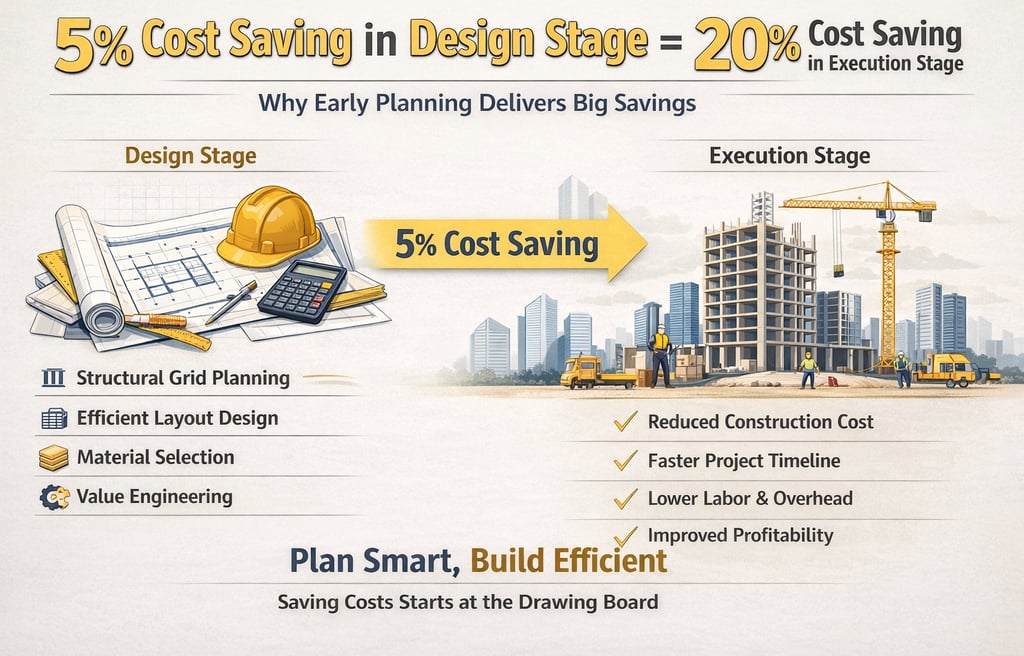
In real estate and construction projects, cost overruns remain one of the most common challenges faced by developers. While many stakeholders focus heavily on controlling costs during execution, the most significant opportunity to reduce project cost actually lies much earlier, during the design stage. A small and well-planned optimization during the design phase can lead to substantial savings during construction. In many cases, a 5% cost saving achieved during the design stage can result in nearly 20% savings during execution. This is because decisions taken during design influence the entire lifecycle of the project, including quantities, procurement strategy, construction methodology, and project timelines.
The design stage is where most of the project’s cost is effectively locked in, even though the actual expenditure happens later during construction. Elements such as structural grid planning, building layout efficiency, material specifications, façade design, finishing standards, and service planning are finalized at this stage. Along with cost implications, these design decisions also directly impact the time required for execution. Efficient planning during the design stage not only reduces construction cost but also shortens execution timelines, which ultimately contributes to overall cost savings.
Structural grid planning is one of the most important factors influencing both construction cost and execution time. Efficient and uniform grid planning helps optimize beam spans, column sizes, slab thickness, and reinforcement requirements. On the other hand, uneven or irregular grid planning often lead to complex shuttering arrangements, increased reinforcement congestion, and difficult construction sequences. These factors increase labour effort, slow down construction progress, and ultimately increase project cost. Proper structural grid planning not only reduces steel and concrete consumption but also improves construction speed and ease of execution.
Building layout efficiency also plays a major role in cost optimization. Thoughtful planning during the design stage helps reduce unnecessary projections, irregular shapes, and complex architectural features that require additional time for construction. Simple and well-aligned layouts improve productivity at site, reduce labour dependency, and minimize execution challenges. When the layout is optimized, repetitive construction activities become easier, resulting in faster construction and reduced project duration.
Material selection is another critical factor that significantly influences project cost and execution efficiency. Decisions regarding materials during the design stage determine procurement strategy, construction methodology, labour requirements, and long-term maintenance costs. Often, over-specification of materials leads to unnecessary increase in project cost without adding proportional value. By carefully selecting appropriate materials based on project requirements, developers can optimize both cost and performance. Standardization of materials also plays an important role in reducing wastage and improving construction speed. For example, standardized tile sizes reduce cutting losses, uniform door and window sizes reduce fabrication cost, and modular planning improves installation efficiency. Similarly, choosing appropriate walling materials such as AAC blocks, fly ash bricks, or precast panels based on project scale and timeline can significantly impact both cost and execution speed. When material selection is finalized during the design stage, procurement planning becomes smoother, material availability improves, and execution becomes more efficient.
Value engineering further strengthens cost optimization during the design stage by evaluating alternative solutions that deliver the same functionality at lower cost. Value engineering is not about reducing quality but about improving efficiency and eliminating unnecessary costs. Through value engineering, different construction methods, materials, and design approaches are evaluated to identify the most cost-effective solutions. For example, evaluating precast versus conventional construction methods can reduce execution time and labour dependency. Similarly, optimizing façade systems, selecting alternative flooring materials, or simplifying finishing specifications can significantly reduce overall project cost. Value engineering also helps in reducing complexity in design, which improves constructability and accelerates execution timelines. When these decisions are taken early, they prevent costly changes during construction and improve project predictability.
Execution time is also influenced by design complexity. Complex structural systems, irregular beam alignments, varying slab levels, and excessive cantilevers increase construction difficulty and slow down progress. On the other hand, standardized and repetitive design elements enable faster construction, better resource utilization, and improved site productivity. Reduction in execution time directly reduces overhead costs, labour costs, equipment costs, and financing costs, which significantly impacts overall project profitability.
Once construction begins, opportunities to reduce execution time and cost become limited. Any changes during execution often lead to rework, delays, and increased overhead costs. Therefore, early planning during the design stage remains the most effective strategy for cost control and efficient project delivery.
Developers who focus on optimized design planning benefit from reduced construction time, improved productivity, lower overhead costs, and better financial outcomes. Early coordination between architectural and structural planning also improves constructability and reduces execution challenges.
In construction and real estate development, the principle remains simple: the earlier the planning, the greater the savings. A 5% saving achieved during the design stage may appear small, but its impact multiplies during execution through reduced quantities, faster construction, and improved efficiency. Smart developers understand that cost control does not start at the construction site; it begins at the drawing board, where better structural grid planning, optimized material selection, and effective value engineering lead to significant savings in both cost and time.
OUR ADDRESS
511, Swanik Arcade, Near Vardan Tower, Pragatinagar, Ahmedabad. 380013
CONTACT US
info@triuneconsultants.co.in
+91 99986 58037
+91 76009 58037
WORKING HOURS
Monday - Saturday
9:00 - 19:00
© 2025. All rights reserved Triune Consultants Private Limited